

A longtime Portland drug treatment center is shuttering as similar programs for moms face trouble
The closure of the 37-year-old Letty Owings Center comes as substance use during pregnancy has increased
The closure of the 37-year-old Letty Owings Center comes as substance use during pregnancy has increased

The closure of one Southern Oregon facility highlights barriers to expanding care for kids with complex behavioral health needs

A former student alleged district administrators failed to intervene and protect her from being sexually abused by an English teacher

The closure of the 37-year-old Letty Owings Center comes as substance use during pregnancy has increased

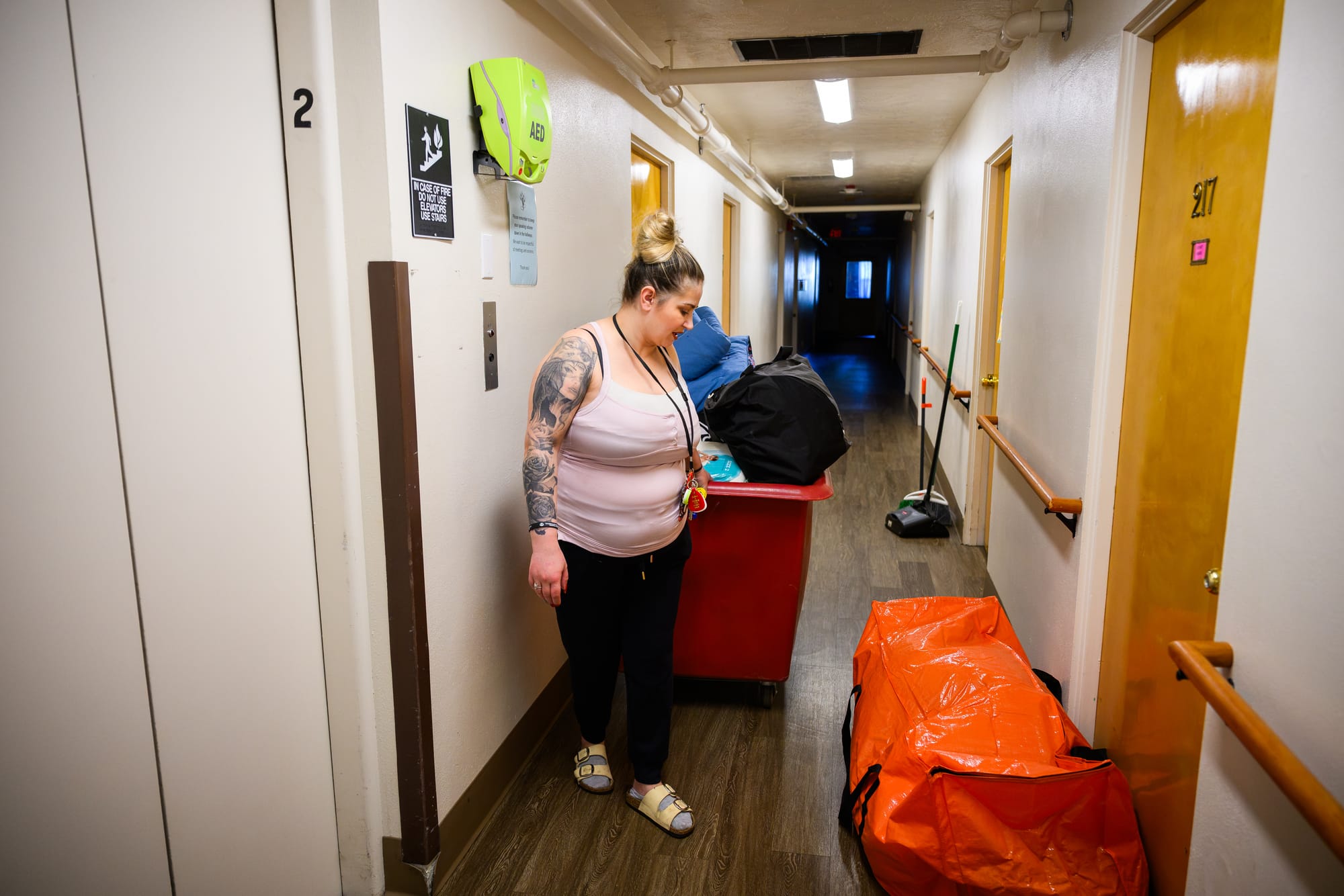
Room 219 at the Letty Owings Center in northeast Portland doesn’t look like much more than a cramped dorm room, but it’s where Ashley Amorim spent her first night with Jeremiah, the smiley, blue-eyed baby who she said gave her the motivation to change her life.
Inside Oregon’s largest residential treatment center for pregnant and parenting women, Amorim spent the past four months working to break what she said was a 16-year cycle of using drugs. She took her medication each day and wrote down goals and strategies to prevent relapse. She processed grief and trauma with other moms and counselors. Child welfare workers allowed four-month-old Jeremiah to spend two nights a week with her, critical bonding time that most residential treatment programs can’t accommodate.
For 37 years, the center has offered mothers with children up to age 5 one of their best shots at accessing treatment while avoiding separation through foster care.
“It’s a great program,” Amorim, 36, said. “It saved my life, and I am very grateful to have been a part of it.”
But Amorim was one of its last residents.
At the end of October, the center will close permanently, capping a year in which Oregon has lost around 20% of its residential treatment beds for pregnant and parenting people, InvestigateWest estimated. The losses come as research shows opioid use during pregnancy has increased substantially over the past decade, and substance use and mental health are the leading causes of maternal deaths in Oregon during pregnancy through the first year postpartum.
Fewer beds means fewer mothers will enter treatment, which will lead to more families separated through foster care and more lives at risk, said Diana Louise Smith, a certified nurse midwife and clinical lead for Project Nurture, an outpatient program through a Portland hospital that integrates substance use treatment and maternal health care.
“We’re probably going to see people die as a result of Letty closing. Every week, people (are) giving birth to their kids and then not having a place to go to treatment,” Smith said.
Letty’s closure reflects the broad challenges faced by centers serving pregnant women with substance use disorders, including federal funding cuts, aging infrastructure and rising costs to provide care as increasingly potent drugs have made both mothers and babies sicker.
Leaders from three other programs serving pregnant and parenting people said they have raised alarms with the Oregon Health Authority in recent years. A spokesperson for Oregon Gov. Tina Kotek said the governor has directed the health authority and the Oregon Department of Human Services to create a cross-agency team to find solutions. Health officials said it will kick off this month.
“This work is urgent, and the team will be partnering closely with providers to identify practical recommendations that address immediate risks, underlying systemic funding, and operational concerns,” wrote Kim Lippert, a communications officer for the Oregon Health Authority, in an email.
But Letty’s former residents, a dwindling crew of staff and community partners said they are grieving and worried about what the loss of the center’s 29 beds means for the growing number of people who need both addiction care and parenting support. Central City Concern, the nonprofit that ran Letty, is also closing Laura’s Place, a transitional housing facility where about 16 women and their children lived each year after finishing treatment at Letty.
“I just wonder, are we the canary in the coal mine?” said Tina Bialas, director of the Letty Owings Center, who will be laid off at the end of November. “I think we are.”
When Lynn James-Kiona showed up at the Letty Owings Center in 1991, she didn’t know what to expect from treatment. But after losing custody of two children while she was deep in her addiction, she was willing to do whatever it took to keep her new son.
That meant confronting the challenges of being both newly sober and postpartum. Letty Owings and programs like it specialize in caring for both mothers and children during those transitions. Staff hold babies to let mothers get a few hours of sleep or bottle feed them when breastfeeding is difficult. Women connect with their peers and learn new skills through financial literacy, grief and parenting classes, while their children receive care at in-house licensed child care centers.
James-Kiona said counselors helped her understand how intergenerational trauma factored into her addiction, as a Black woman and a member of the Yakama Nation whose mother had been cut off from her language and culture after she was sent to boarding school. Separation from her own children had left James-Kiona with familiar wounds and fears.

She recalled nights when she would try to fall asleep and wake up feeling paralyzed, her body "reliving something my mind couldn't remember." When she emerged from that state, a woman working the graveyard shift would fold laundry and talk with her through the night. Letty's staff showed her and her son unconditional love, she said.
"I didn't get that nowhere — not even from my own mom or my own community. I was always judged, you know, about what I got and what I don't got, and they took me with nothing but the clothes on my back and pregnant, and let me in," James-Kiona said.
Thirty-five years later, James-Kiona is now a tribal elder and founder of the Mary Kiona Foundation, a nonprofit named after her late ancestor that focuses on community services and housing. More than a decade ago, she reconciled with her children she lost custody of. Her son, who stayed with her at Letty Owings, is now a real estate broker with five children of his own.
“I don't think people understand how healing a family is way bigger than just getting clean,” James-Kiona said. “I don't think people understand what places like this could do, and how powerful children are. Now I'm able to be there not only for my kids, but for my grandchildren, too.”


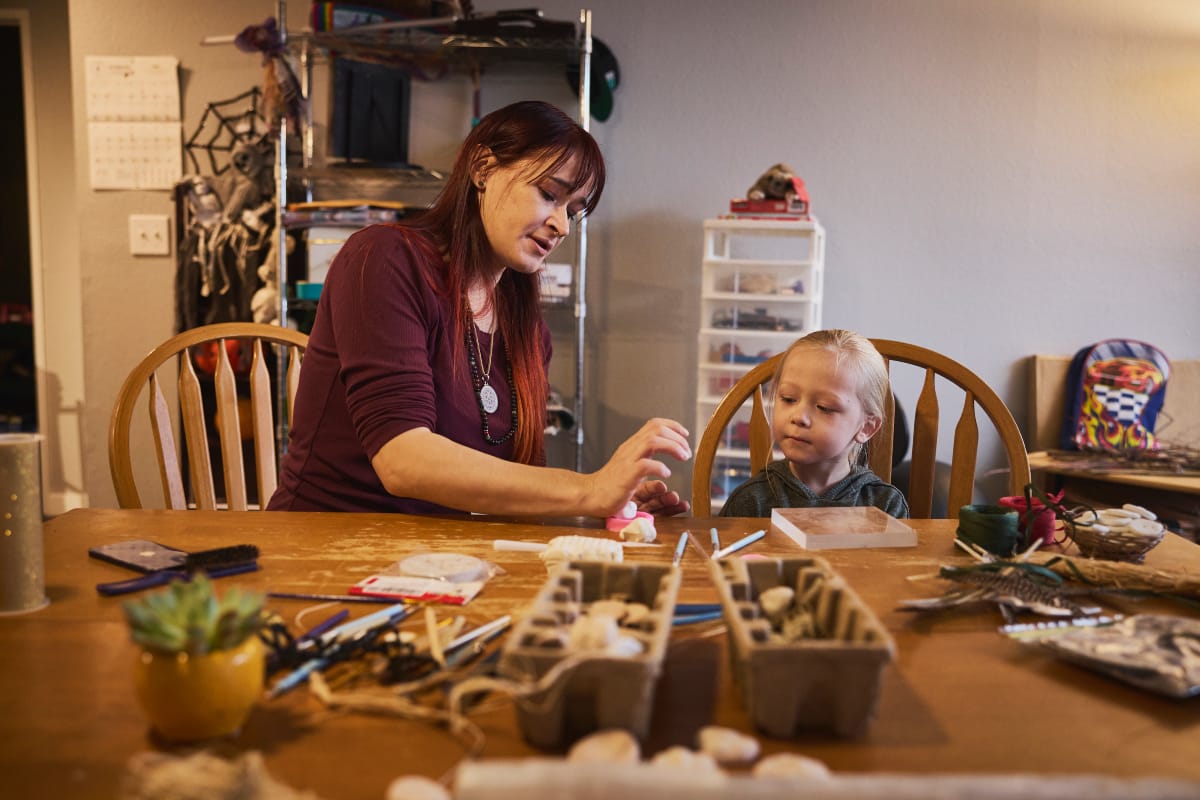
The craft room of the Letty Owings Center in Portland, Oregon. (Molly J. Smith/Investigate West)
Central City Concern said thousands of mothers have come through the Letty Owings Center since its founding in 1989. Over its nearly four-decade existence, Oregon’s demand for substance use treatment has only grown. The state’s rate of substance use disorders exceeds the national rate, and its overdose death rate climbed for most of the past two decades. Overdose deaths began to drop in 2024, but health officials are uncertain how federal health care cuts might impact that trend.
Growing the state’s supply of residential treatment beds has been a priority of Kotek’s administration since she took office in 2023. While investments from the state legislature and health authority have helped spur the creation of more than 200 new beds, with another 400 in development, beds for pregnant people aren’t specifically tracked.
The state also doesn’t track prevalence of substance use disorders among pregnant people. Dr. Andy Mendenhall, chief executive officer of Central City Concern, cited an analysis by HealthShare of Oregon, a coordinated care organization serving the majority of Portland-area Medicaid enrollees, which estimated that around 550 pregnant people needed treatment for psychosis, stimulant or opioid use disorders in 2024. Even if only a quarter of those patients needed residential treatment, they would likely exceed the entire state’s bed capacity for pregnant and parenting people today. Capacity can fluctuate based on a facility’s staffing and the needs of its clients, but InvestigateWest estimated that roughly 120 of those beds remain, most located along the I-5 corridor.
 Kaylee Tornay
Over the past decade, women have also been coming to facilities like Letty with more serious health issues, program leaders said. Purer and more potent methamphetamine has spurred more mental health crises and psychosis. Fentanyl takes a long time to leave the body, so people need more time in treatment and higher doses of methadone and buprenorphine.
“We'd see a lot of folks really struggling with sleep, struggling with staying awake during the day, struggling with their mood, struggling with unusual thoughts,” said Dr. Amanda Risser, chief medical officer for Central City Concern.
Programs must also be equipped to support women with health complications often linked to homelessness or low access to prenatal care. Pregnant women with substance use disorders are at increased risk for hemorrhage and preeclampsia. Their babies are more likely to be born premature and underweight and some experience neonatal abstinence syndrome. Letty Owings staff transported women to and from medical appointments and to visit their children in the neonatal intensive care unit.
Several programs for pregnant people and mothers were created in response to rising use of heroin and crack cocaine in the late 1980s and early ’90s. Northeast Portland was particularly hard hit. Nancy Anderson, a Portland mother in recovery, and Letty Owings, a longtime high school teacher in Lake Oswego, co-founded their center because they saw firsthand that when mothers couldn’t access treatment that accommodated their children, it often meant they didn’t get treatment at all — which could be deadly for both them and their children. Ecumenical Ministries of Oregon ran the center until 1997, when Central City Concern took over.
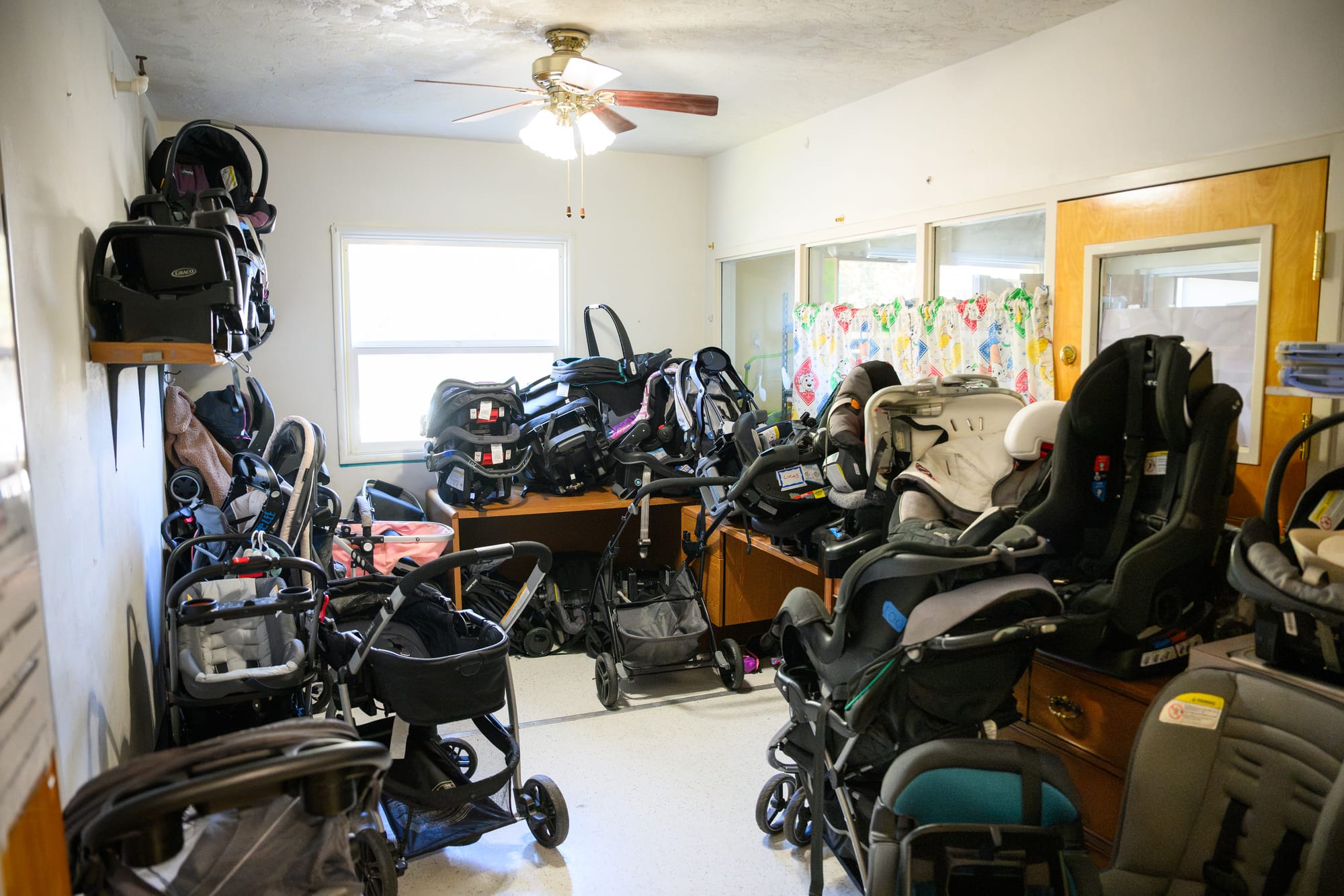
Funding for Letty Owings is a patchwork of Medicaid billing, grants and contracts, and fundraising to fill gaps. The community has long lent support and resources. Over the decades, there were diaper drives and furniture donations. Bialas, Letty’s director since 2021, recalled how churchgoers in West Linn and Portland made quilts for women graduating from the home and bought Christmas gifts for the children staying at Letty.

“Church grandmas and grandpas write out their $25 checks,” Bialas said. Suddenly her face crumpled and tears spilled down her cheeks.
“It breaks my heart I have to tell them that we’re closing,” she said.
Central City Concern leaders said they hit a breaking point with the Letty Owings Center this summer, when they were confronted with a growing deficit and the building’s need for expensive repairs. They also hit dead ends trying to transfer management of the program to another provider.
Mendenhall said they considered restructuring Letty’s operations because of the growing needs of its clients. But that would increase costs by $2 million each year, while Letty’s projected deficit in 2027 was already $1 million.
That, along with the updates needed to keep the building operational, “made the juice not worth the squeeze,” he said. The nonprofit’s 2025 revenues exceeded $200 million, but it is also bracing for losses through cuts to Medicaid that are beginning to take effect this year.
Even with extended timelines, no other provider had the capacity to take over Letty, Mendenhall said. It “speaks to just the compression and the strain” on the entire landscape of providers, he said.
Closures can happen without much warning. When a Portland women’s residential treatment center run by Volunteers of America Oregon announced a temporary pause in operations in April, its staff had to scramble to find safe places for 47 clients staying there. Five people who were pregnant or postpartum went to Letty Owings. Volunteers of America Oregon then told staff the closure was permanent on April 16.
Letty Owings stopped new admissions in July, just two months before leaders announced it was closing, too.
InvestigateWest spoke to the heads of three other residential treatment programs that either focus exclusively on pregnant and parenting mothers, or reserve several beds for them within their women’s center. Each one said existing funding streams don’t account for the variety of costs involved with caring for both a mother and young child impacted by substance use and trauma.
Centers often don’t have reliable ways to recoup the costs of providing clothes, diapers and food, transportation to and from appointments, or the skill-based classes that help parents satisfy child welfare requirements to maintain or regain custody of their children.
Then there are the costs to maintain buildings. Some programs receive “room and board” reimbursements that pass through counties — but Bialas and others said those funds only cover a fraction of the real cost. More health complications have meant more prescriptions, which means more staff needed to supervise while clients self-administer doses of sometimes a dozen or more medications.
“There is an expectation: ‘Oh, this must be the most beautiful time in your life, you had a new baby,’” said Eva Williams, executive director of Willamette Family, which operates a residential program that can accommodate 16 to 20 women, depending on how many have children. The picture is more complicated when mothers are simultaneously experiencing withdrawal, adjusting to new medications and recovering from birth, she said. “All of that together requires a substantial amount of care.”
Williams said her program is “suffering deeply” in the current funding environment and that state officials have only recently started paying attention. Francesca Barnett, senior program director of Project Network, another Portland residential drug treatment program focused on Black mothers, said it was “frustrating” that health and child welfare officials launched their team to find solutions only after the Volunteers of America Oregon and Letty Owings closures.
“We needed that before they had to make that choice,” she said.
State leaders said they recognize the loss of beds is significant and they intend to act.
“Keeping families together while parents receive care benefits the whole family,” wrote Hanna Thomas, spokesperson for Kotek, in an email. “The governor believes pregnant and parenting women and their families deserve quality, holistic behavioral healthcare and she is committed to working towards that reality in Oregon.”
State Rep. Rob Nosse, whose district includes the center, said he planned to meet with Central City Concern to learn more, calling the center a “badly needed” resource. State Sen. Lisa Reynolds, a pediatrician who has focused on perinatal health and babies in her work as a lawmaker, said she’s exploring whether legislation can address those funding problems.
“I'm working with a group of providers specifically on … where we can cut red tape, where we can change the bureaucracy,” she said, adding that Letty’s closure has “changed the timeline.”
As Amorim prepared to leave the Letty Owings Center, the building that once bustled with nearly 20 other moms and their kids was already growing quieter and emptier. On Amorim’s moveout day on Oct. 8, she packed up her things in a mostly vacant hall.
Among her belongings was a baby swing for Jeremiah, a handmade quilt and a custom sobriety coin shaped like a sunflower, with the words love, hope, spirit and faith blooming at the center.
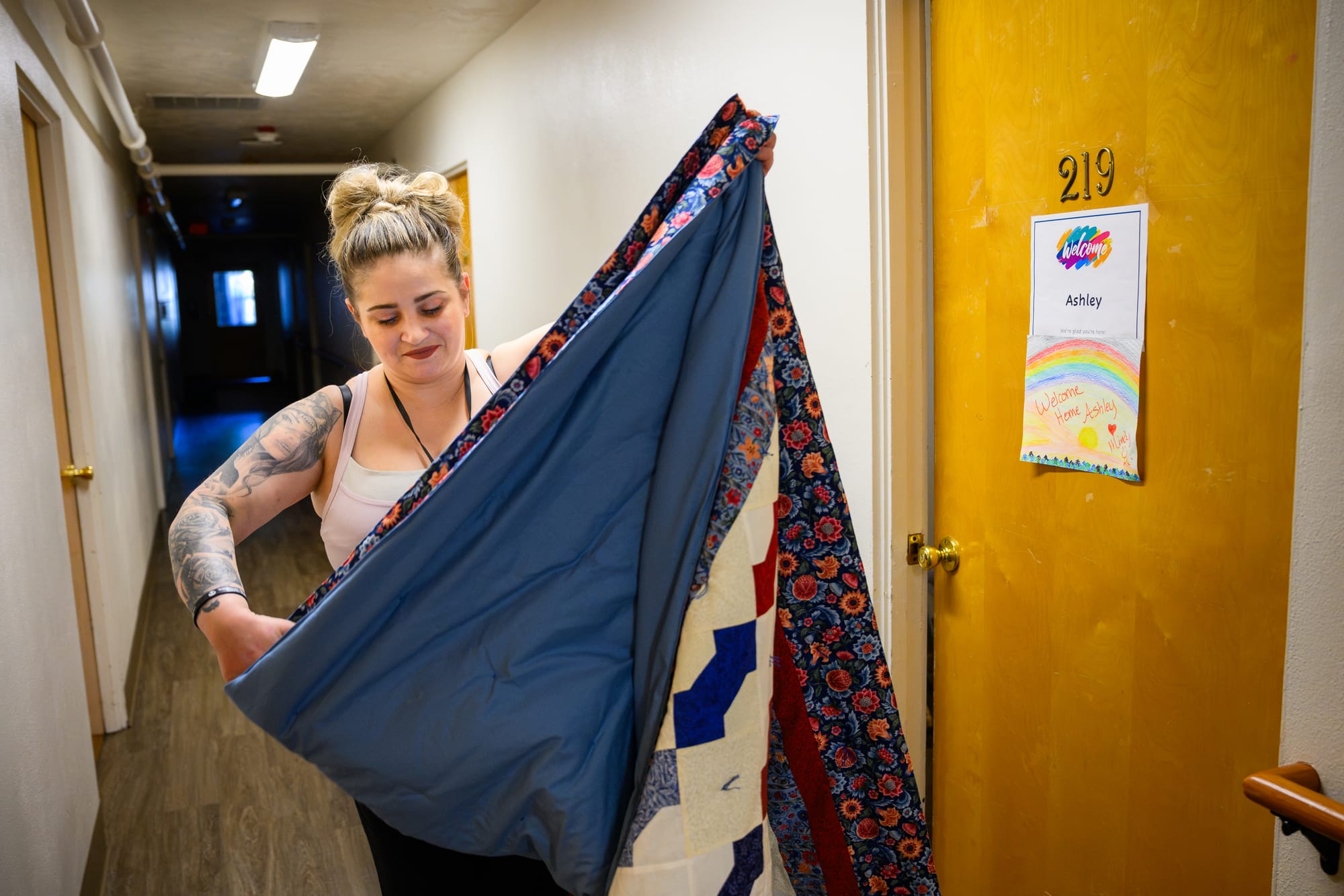

Ashley Amorim folds a blanket gifted to her by a local church group as she moves out of the Letty Owings Center in Portland, Oregon, on Thursday, Oct. 8, 2026. On the left, Amorim holds a sobriety coin she was presented to mark her graduation from the facility. (Molly J. Smith/Investigate West)
“It's really sad to me that they're closing and are not going to be able to help any more women and children," Amorim said. “What are we going to do now? How are they going to get the help that they need?”
In one way, Letty’s closure helped Amorim, since she had to return to the hospital several times for treatment for infections. The pause on admissions allowed her to retain her spot in a program that usually had more than 20 women on the waiting list.
After moving out of Letty to the Hillsboro clean and sober house where she now lives, Amorim, Jeremiah and his father, Brian, who also completed treatment this year, have gotten to spend their first days together as a family of three. Child welfare is still involved, but Amorim said she and Brian are so far on track to regain full custody of their son.
She thinks Jeremiah would have had a very different future if not for Letty.
“Seeing my son for the first time and holding him has made every single thing worth it,” Amorim said. “Really, it has been challenging, but at the same time, it's been nothing but motivation for me to just do better and to be better for him.”
The story you just read is only possible because readers like you support our mission to uncover truths that matter. If you value this reporting, help us continue producing high-impact investigations that drive real-world change. Your donation today ensures we can keep asking tough questions and bringing critical issues to light. Join us — because fearless, independent journalism depends on you!
— Jacob H. Fries, executive director
DonateCancel anytime.

The closure of one Southern Oregon facility highlights barriers to expanding care for kids with complex behavioral health needs

The board of 5Rock Ranch nearly shut it down more than a decade ago, but former residents say harmful practices continue

State lawmakers wary of government spending have turned down bills to fund emergency medical services

Shereef Elnahal, who has served as president since August, said the hospital needs to stabilize its finances before it can resume the project
The closure of one Southern Oregon facility highlights barriers to expanding care for kids with complex behavioral health needs

A former student alleged district administrators failed to intervene and protect her from being sexually abused by an English teacher

Despite concerns newsroom staffers shared with InvestigateWest and RANGE, the nonprofit taking over Spokane’s daily paper plans to keep Curley in a leadership role

As Klickitat County Sheriff Bob Songer retires, candidates have distanced themselves from some — not all — of Songer's most controversial positions
Subscribe to our weekly newsletters and never miss an investigation.